
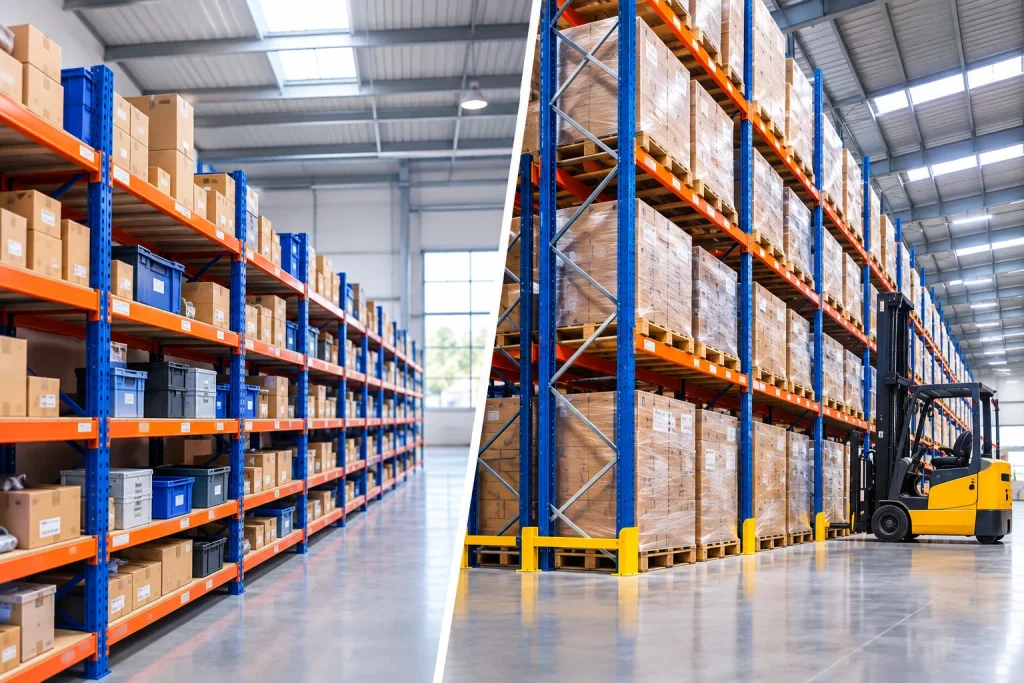
Choosing the right warehouse racking system is essential for efficient storage, safe operations, and better use of available floor space. Two of the most commonly considered options are medium duty racking and heavy duty racking.
Although both systems are designed to organise inventory vertically, they serve different storage requirements. The right choice depends on factors such as load weight, product dimensions, warehouse layout, accessibility, storage volume, and future business needs.
If you are planning a new warehouse or upgrading an existing storage area, understanding the difference between medium duty and heavy duty racking can help you invest in a system that provides the right balance of capacity, safety, and efficiency.
What Is Medium Duty Racking?
Medium duty racking is designed for storing products and materials that require more capacity than light-duty shelving but do not require the extremely high load-bearing capacity of heavy-duty warehouse systems.
It is commonly used in warehouses, workshops, retail stockrooms, distribution facilities, and commercial storage areas.
Medium duty racking can accommodate a wide range of boxed goods, spare parts, tools, packaged products, and general inventory. Depending on the configuration and manufacturer specifications, shelves can be adjusted to suit different product sizes.
Benefits of Medium Duty Racking
- Suitable for moderate-weight inventory
- Adjustable shelf levels
- Efficient use of vertical space
- Flexible warehouse configuration
- Suitable for manual picking
- Easier access to individual products
- Suitable for warehouses with varied inventory
- Cost-effective for moderate storage requirements
Medium duty systems are particularly useful when warehouse employees need frequent access to products without relying heavily on forklifts or other specialised handling equipment.
What Is Heavy Duty Racking?
Heavy duty racking is engineered for warehouses that need to store heavier loads, larger quantities, or palletised inventory. These systems are generally constructed using stronger frames, beams, and components designed to handle higher loads.
Heavy duty pallet racking is widely used in logistics centres, manufacturing facilities, automotive businesses, distribution warehouses, and industrial storage environments.
Products can often be stored on pallets, allowing forklifts or other material-handling equipment to access inventory efficiently.
Benefits of Heavy Duty Racking
- High load-bearing capacity
- Suitable for palletised goods
- Efficient use of warehouse height
- Designed for industrial applications
- Supports larger inventory volumes
- Compatible with forklift operations
- Can be configured for different warehouse layouts
- Suitable for long-term storage requirements
For businesses handling heavy machinery parts, bulk materials, pallets, automotive components, or industrial products, heavy duty racking can provide the structural capacity required for safe and organised storage.
Which Racking System Should You Choose?
The best warehouse racking solution depends on your specific storage requirements rather than simply choosing the system with the highest capacity.
1. Consider the Weight of Your Products
Start by determining the average and maximum weight of the products you need to store.
If your inventory consists mainly of cartons, packaged products, spare parts, or moderately heavy items, medium duty racking may be sufficient.
If you are storing pallets, machinery components, bulk materials, or other heavy products, heavy duty racking is generally more appropriate.
2. Think About How Products Are Handled
Consider how employees retrieve and move inventory.
For warehouses where products are manually picked from shelves, medium duty racking can provide convenient access.
For palletised inventory that is moved using forklifts, heavy duty pallet racking may be a better solution.
3. Assess Your Warehouse Height
Vertical space is one of the most valuable assets in a warehouse. A suitable racking system allows you to take advantage of available height while maintaining safe access to products.
Heavy duty pallet racking can be particularly effective in warehouses with high ceilings and large inventory volumes.
However, rack height should always be planned around building conditions, handling equipment, safety requirements, and applicable regulations.
4. Consider Your Inventory Turnover
Businesses with frequently changing stock may need a system that provides quick and convenient access.
Medium duty shelving can work well for businesses that manually pick individual products regularly.
For large volumes of palletised inventory, a heavy duty system can provide better storage density and organised access.
5. Plan for Future Growth
Warehouse requirements can change as your business grows.
Choosing a racking system solely based on today’s inventory may result in costly modifications later. Consider whether product quantities, product weights, warehouse height, or operational requirements are likely to increase.
A professional warehouse storage assessment can help you choose a system that supports both current and future requirements.
Can You Combine Medium Duty and Heavy Duty Racking?
Yes. In many warehouses, using a combination of storage systems can be an effective approach.
For example, a warehouse could use heavy duty pallet racking for bulk inventory and medium duty shelving for smaller products, spare parts, tools, or picking areas.
This approach allows businesses to match each storage area to the type and weight of inventory being handled.
Safety Considerations for Warehouse Racking
Regardless of whether you choose medium or heavy duty racking, safety should be a priority.
Racking should be correctly designed, installed, loaded, and maintained. Operators should follow the manufacturer’s load specifications and avoid exceeding the rated capacity.
Regular inspections can also help identify damaged frames, beams, connectors, or other components before they become a serious problem.
Clear aisle space, suitable loading practices, appropriate forklift operation, and visible load-rating information can further support safer warehouse operations.
Why Professional Racking Design Matters
Selecting individual rack components without considering the entire warehouse layout can lead to inefficient storage and operational problems.
A professional racking supplier can assess your available space, inventory, load requirements, access requirements, workflow, and future expansion plans.
The resulting layout can be designed to improve storage capacity while maintaining practical access and safe movement throughout the warehouse.
Final Thoughts: Medium Duty or Heavy Duty Racking?
There is no single racking system that is right for every warehouse.
Medium duty racking is a practical choice for moderate-weight inventory, manual picking, general storage, workshops, and commercial applications. Heavy duty racking is better suited to high-load, palletised, industrial, and high-volume warehouse environments.
Before making a decision, consider product weight, storage volume, handling methods, warehouse height, available floor space, safety requirements, and future growth.
For businesses looking for professionally planned racks and shelves in Qatar, Orientech Racking can help identify a storage solution suited to the warehouse’s operational and inventory requirements. Choosing the right system from the beginning can improve organisation, maximise available space, and support more efficient warehouse operations.
Frequently Asked Questions
1. What is the difference between medium duty and heavy duty racking?
Medium duty racking is designed for moderate-weight products and is commonly used for manual picking and general storage. Heavy duty racking is designed for higher loads and is often used for pallets, bulk products, industrial inventory, and forklift-accessed storage.
2. Is medium duty racking suitable for warehouses?
Yes. Medium duty racking is suitable for warehouses storing products that do not require heavy load capacities. It can be used for cartons, spare parts, tools, packaged goods, and general inventory.
3. When should I choose heavy duty racking?
Heavy duty racking is generally appropriate when your warehouse stores heavy products, palletised inventory, bulk materials, or large quantities of goods. It is also useful when forklift access and higher storage capacity are required.
4. Can medium duty and heavy duty racking be used together?
Yes. Combining both systems can be an effective warehouse storage strategy. Medium duty shelving can be used for smaller or manually picked items, while heavy duty pallet racking can handle heavier or palletised inventory.
5. How do I choose the right warehouse racking system?
Consider the weight and dimensions of your products, storage volume, warehouse height, available floor space, handling equipment, accessibility, safety requirements, and future expansion plans. A professional racking assessment can help determine the most suitable configuration.